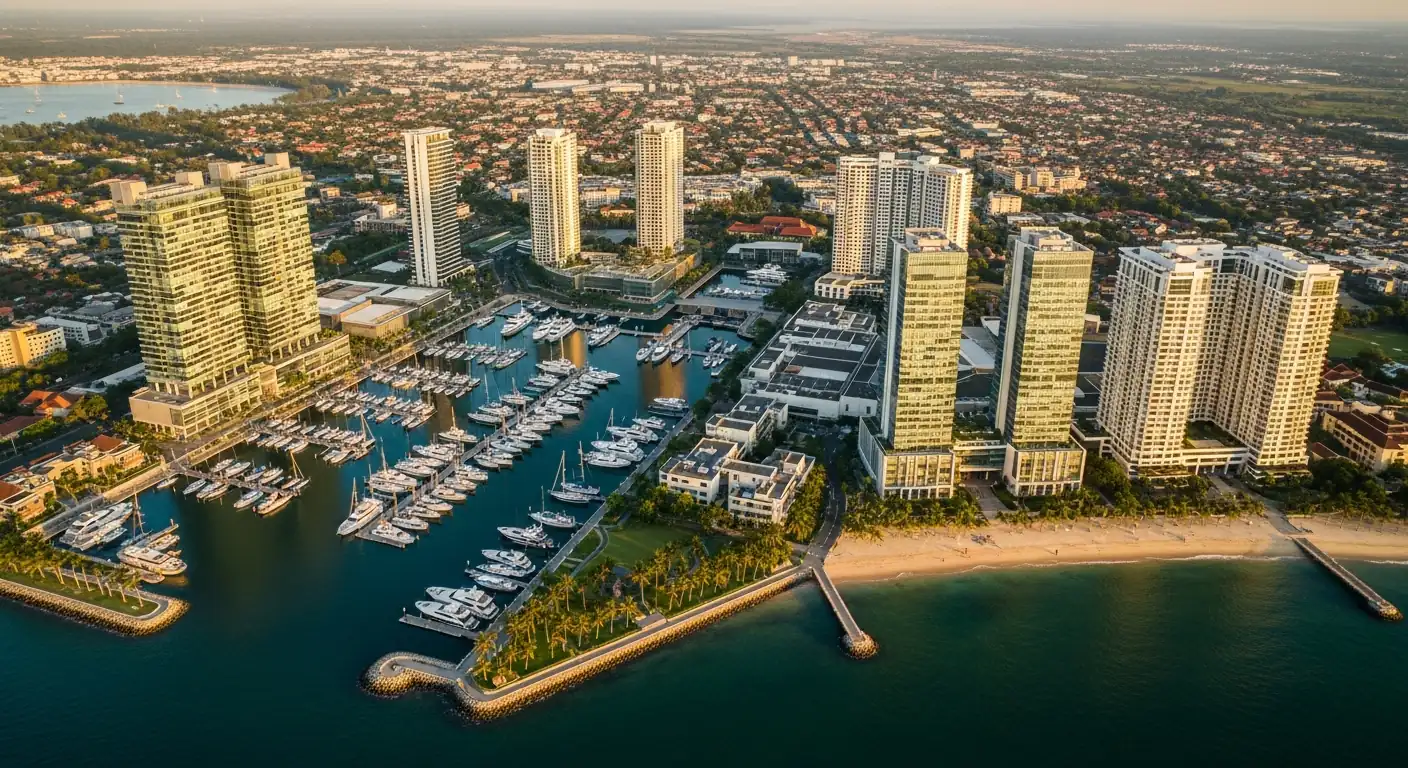
The morning light catches the distinctive architectural profiles emerging from the KEK Kura-Kura Bali, signaling the advent of the Kura Kura IFC, a strategic financial district planned for the Indonesian archipelago. This independent editorial reference explores the Kura Kura International Financial Center, examining its regulatory framework, investor zones, and its comparative standing against established global financial hubs like Dubai DIFC and Singapore. This analysis is crafted for institutional investors, family offices, fund managers, and policy analysts observing the development of the KEK Kura-Kura financial district and the Bali IFC rollout.
The Vision for Kura Kura IFC: An Integrated Financial District
The Kura Kura IFC represents a significant commitment to establishing a new economic nexus in Southeast Asia. The name Kura Kura IFC indicates a planned integrated financial district rather than an individual office tenant, underscoring its scope as a comprehensive urban development. The vertical category kura-kura-ifc-financial-district implies a direct focus on financial services and commercial office space, positioning it as a dedicated environment for global finance. The project is associated with the domain kurakuraifc.com, which serves as its primary online presence for stakeholders seeking information. The term IFC in the project name typically denotes an International Financial Center in global real estate branding, a designation that carries specific expectations for infrastructure and regulatory support. Financial district developments branded as IFC commonly include multiple office towers and supporting retail facilities, designed to create a self-contained ecosystem for business and leisure. Such financial district projects are usually designed to host banks, investment firms, and professional service companies in a single precinct, fostering collaboration and efficiency. The Kura Kura IFC aims to attract a diverse range of financial institutions, from multinational banks to specialized asset management firms and FinTech innovators, by offering a conducive operational environment. The master plan for the district includes provisions for high-speed data connectivity, robust security protocols, and sustainable building practices, aligning with contemporary global standards for financial centers.
Regulatory Roadmap and Investor Zones within KEK Kura-Kura Bali
The regulatory framework for the Kura Kura IFC is intrinsically linked to its location within the KEK Kura-Kura Bali, a Special Economic Zone (SEZ). This designation provides a foundation for attractive fiscal incentives and streamlined administrative processes, crucial for drawing international investment. The Indonesian government, through various ministries, is actively shaping the legal and operational landscape to ensure the Kura Kura IFC can compete effectively on a global stage. Discussions regarding specific tax holidays, expedited licensing procedures, and foreign ownership regulations are central to its appeal. The KEK Kura-Kura Bali offers specific investor zones tailored to different types of financial activities and commercial real estate development. These zones are designed to support the construction of office tower planning, mixed-use master planning, and urban infrastructure design that meet the stringent requirements of financial institutions. Property management within these zones will be investment-grade, ensuring the long-term value and operational efficiency of the assets. The regulatory roadmap includes provisions for a specialized financial services authority within the KEK, intended to provide a clear and stable supervisory environment for firms operating within the Kura Kura IFC. This authority will likely oversee licensing, compliance, and dispute resolution, offering a predictable operational environment. The legal framework is being developed with an eye towards international best practices, aiming for transparency and robustness to instill confidence among prospective investors.
The Role of KEK Status in Attracting Investment
The Special Economic Zone (KEK) status of Kura-Kura Bali is a cornerstone of the Kura Kura IFC’s value proposition. This status allows for deviations from standard national regulations, offering a more investor-friendly environment. For instance, foreign direct investment regulations can be more flexible, potentially allowing for greater foreign ownership percentages in key sectors within the KEK. Import duties and value-added tax (VAT) exemptions for certain goods and services, particularly those related to the construction and operation of financial infrastructure, are also under consideration. The KEK framework also facilitates a more efficient land acquisition process and provides for a one-stop service for permits and licenses, significantly reducing bureaucratic hurdles for large-scale developments like the Kura Kura IFC. This streamlined approach is critical for the timely execution of integrated financial districts, where complex interdependencies between commercial real estate development, office tower planning, and urban infrastructure design demand coordinated efforts. The KEK status also allows for the establishment of a dedicated KEK authority with specific powers to manage and regulate activities within its boundaries, ensuring a focused approach to the development and operation of the financial center. This authority will be instrumental in implementing the investment-grade property management standards required for a successful IFC.
Prabowo’s Endorsement and Strategic Importance
The Kura Kura IFC holds significant strategic importance, underscored by its association with President-elect Prabowo Subianto. His endorsement signals a high level of governmental support and commitment to the project, elevating its national priority. This backing is crucial for a large-scale integrated financial district that requires substantial public and private sector coordination. The project aligns with Indonesia’s broader economic development goals, aiming to diversify its economy and strengthen its position as a regional financial hub. The Kura Kura IFC is envisioned as a catalyst for economic growth, generating employment opportunities and attracting foreign capital. Its location on Pulau Serangan, within the KEK Kura-Kura Bali, places it in a geographically advantageous position within Southeast Asia, offering connectivity to key regional markets. The development is designed to integrate seamlessly with the existing infrastructure of Bali while also introducing new, advanced urban infrastructure design elements. The Kura Kura IFC is not merely a collection of office towers; it is a strategic initiative to create a dynamic ecosystem that supports the entire financial services value chain. The KEK Kura-Kura Bali, spanning 498 hectares, provides ample space for this integrated development, including residential, commercial, and tourism components alongside the financial district.
Comparative Analysis: Kura Kura IFC vs. Dubai DIFC and Singapore
To understand the potential trajectory of the Kura Kura IFC, a comparative analysis with established international financial centers like Dubai DIFC and Singapore is essential. Dubai DIFC, a leading financial hub in the Middle East, offers a common law framework, an independent regulator, and 100% foreign ownership, which have been key to its success. Singapore, with its robust legal system, political stability, and well-developed financial ecosystem, serves as a benchmark for financial innovation and global connectivity in Asia. The Kura Kura IFC aims to emulate elements of these successful models while tailoring its approach to the Indonesian context. Similar to DIFC, the Kura Kura IFC will focus on integrated financial districts, providing a holistic environment for financial firms. The concept of multiple office towers and supporting retail facilities is a common thread across all these centers. However, the Kura Kura IFC will differentiate itself through its specific regulatory incentives within the KEK Kura-Kura Bali and its strategic location in a rapidly growing ASEAN economy. The challenge for Kura Kura IFC will be to establish a regulatory framework that is equally transparent, predictable, and robust as those in Dubai and Singapore. This includes developing a legal system that instills confidence in international investors and ensuring that investment-grade property management standards are consistently met across the entire development. The project’s success will also hinge on its ability to attract a critical mass of financial institutions and talent, competing with established centers for market share.
Office Tower Planning and Urban Infrastructure Design
The physical manifestation of the Kura Kura IFC involves meticulous office tower planning and sophisticated urban infrastructure design. The integrated financial district will feature a collection of modern commercial office space, designed to meet the specifications of global financial institutions. These towers will incorporate smart building technologies, energy-efficient systems, and flexible floor plates to accommodate diverse tenant requirements. Mixed-use master planning is central to the Kura Kura IFC’s design, integrating commercial, residential, and retail components to create a vibrant and self-sustaining urban environment. This approach is intended to foster a live-work-play dynamic, attracting talent and enhancing the quality of life within the district. Urban infrastructure design will encompass advanced transportation networks, including pedestrian walkways, cycling paths, and potentially an internal transit system, to ensure seamless connectivity throughout the KEK Kura-Kura Bali. Furthermore, robust data infrastructure, including redundant fiber optic networks, is critical for supporting the demanding operational requirements of financial services companies. The development will also prioritize green spaces and sustainable design principles, contributing to a high-quality urban environment. The planning process involves collaboration with international architectural and urban planning firms to ensure the Kura Kura IFC adheres to global best practices in integrated financial districts development.
Investment-Grade Property Management and Market Outlook
The long-term success of the Kura Kura IFC hinges on the implementation of investment-grade property management. This encompasses not only the physical maintenance of commercial real estate development but also the provision of world-class services to tenants, ensuring operational efficiency and tenant satisfaction. For an integrated financial district, property management extends to security, facilities management, and community services, all tailored to the specific needs of financial institutions. The market outlook for the Kura Kura IFC is influenced by Indonesia’s economic growth trajectory and its increasing integration into the global financial system. The project aims to capitalize on the growing wealth in Southeast Asia and the demand for sophisticated financial services. The KEK Kura-Kura Bali’s strategic location and the Indonesian government’s commitment to the project provide a strong foundation. However, the Kura Kura IFC will face competition from established regional financial centers. Its ability to offer a compelling value proposition, including a stable regulatory environment, attractive incentives, and high-quality infrastructure, will be crucial. The ongoing development of the regulatory framework and the phased rollout of the commercial office space will be key indicators for institutional investors and fund managers tracking the project. Market analysis suggests a strong potential for growth, given Indonesia’s demographic dividend and expanding middle class.
Please note: Rules and regulations pertaining to financial centers and special economic zones are subject to change. It is strongly recommended to consult with a licensed Indonesian legal or tax professional for the most current and definitive information before making any investment decisions.
For further insights into the development of the Kura Kura IFC and its role in the global financial landscape, explore the comprehensive resources available on Wikipedia’s page on International Financial Centres and Wikipedia’s page on Special Economic Zones. To continue your exploration of the Kura Kura International Financial Center, look closer into our independent editorial coverage at kurakuraifc.com.